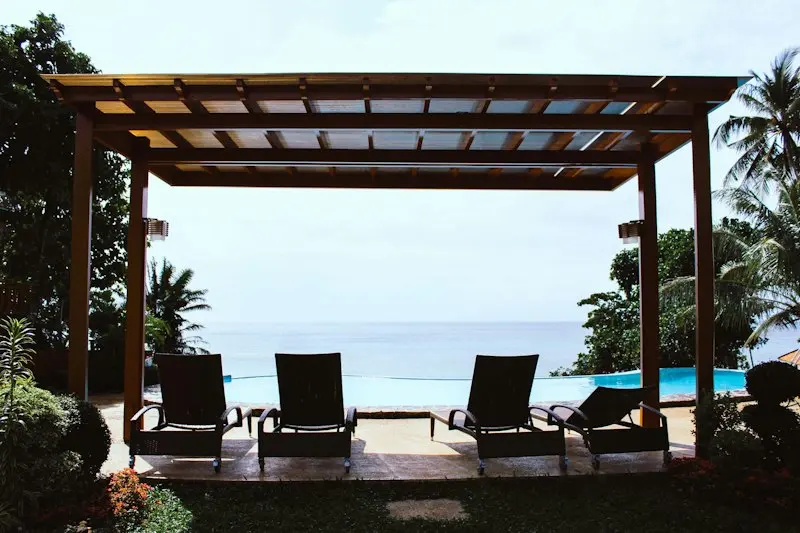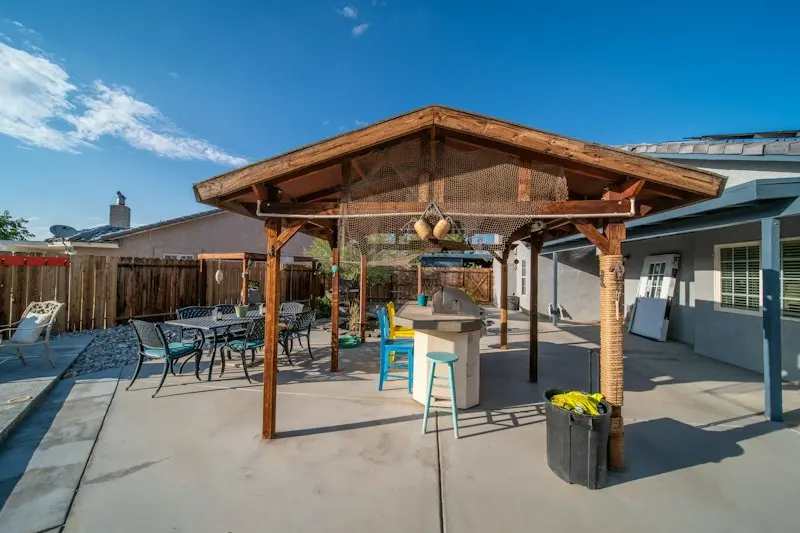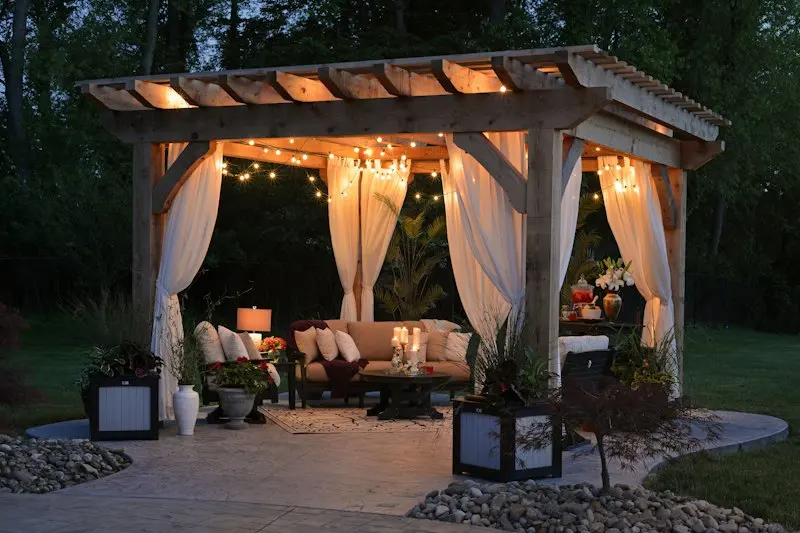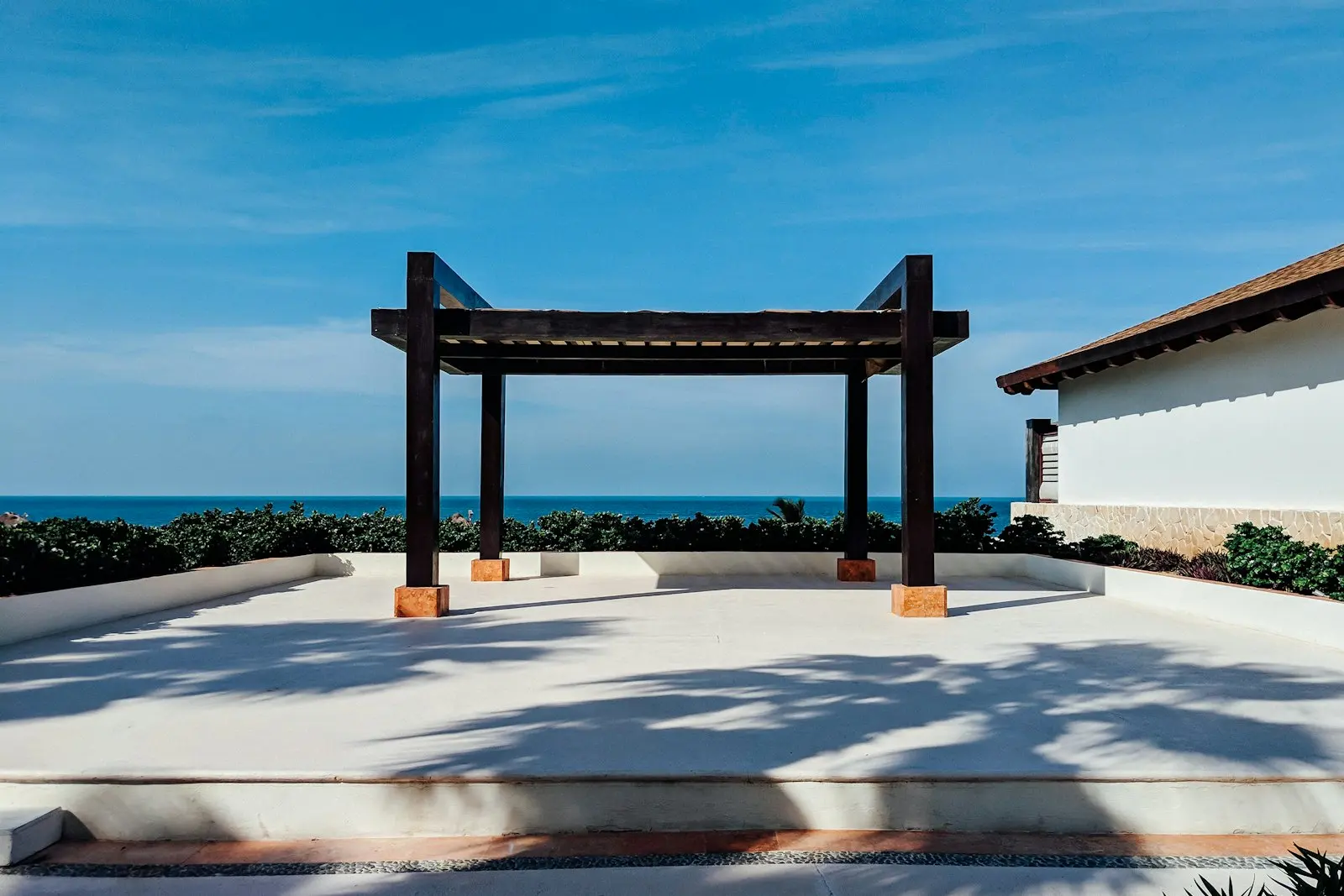
Short answer. A freestanding pergola stands on four or more posts and touches no building. You can put it anywhere with a sound base, and it leaves the house wall untouched. In return, all of its stability comes from its own posts, braces and anchors, so the footings deserve most of your attention.
Key facts
- A freestanding pergola stands on four or more posts and is not fastened to the house, while an attached pergola hangs one side from a ledger board on the wall.
- Freestanding pergola kits are commonly sold in sizes from 10 by 10 feet to 12 by 16 feet, with larger sizes using six posts.
- A freestanding pergola gets all of its resistance to wind from its own posts, braces and anchors, so the footing or anchor method in the manual matters more than on an attached pergola.
- Freestanding pergola kits commonly give about 7 to 8 feet of clear height under the beams.
- A freestanding pergola avoids cutting into the siding of the house, so it needs no ledger board and no flashing.
What is a freestanding pergola?
A pergola that carries all of its own weight on its posts. Most have four posts. Larger ones have six or more.
The top is the same as on any pergola: beams across the posts, then rafters or slats across the beams. The roof can stay open or take a canopy, louvers or panels. See pergola roof options. Most pergola kits sold online are freestanding, because the maker cannot know what your wall is made of.
Pergola attached vs freestanding: which is better?
A freestanding pergola is the more flexible choice. An attached pergola suits a patio right at the back door and saves two posts. The difference is where the load goes and what the house has to give.
| Point | Freestanding pergola | Attached pergola |
|---|---|---|
| Posts | Four or more | Usually two, plus a ledger board on the wall |
| Where it can go | Anywhere with a sound base: patio, lawn, poolside, driveway | Only against a wall that can carry it |
| Effect on the house | None | Holes in the wall, flashing to keep water out, load on the framing |
| Stability | From its own posts, braces and anchors | Partly from the house |
| Permit | Small detached structures are often treated more lightly, but not everywhere | Often needs a permit because it is fixed to the house |
| Cost level | More material, simpler install | Less material, more skilled labor at the wall |
| Moving or removing it | Can be unbolted and moved | Leaves holes and flashing to repair |
The ledger, the flashing and the load on the wall are covered in pergola attached to house vs freestanding. If you like the attached look but not the wall work, a four-post pergola set a few inches off the house is a common middle path.
What sizes do freestanding pergolas come in?
Kits commonly run from 10 by 10 feet to 12 by 16 feet. Bigger sizes exist, usually with six posts or heavier beams.
- 10 by 10 feet: a bistro set or two lounge chairs.
- 10 by 12 or 12 by 12 feet: a dining table for six, or a sofa set.
- 12 by 16 feet and larger: dining plus lounge, or an outdoor kitchen run.
Two figures on the spec sheet matter more than the name of the size. The first is the post-to-post footprint, which is smaller than the roof. The second is the clear height under the beam, commonly about 7 to 8 feet. A ceiling fan or hanging light takes some of that height away.
Does a freestanding pergola need footings?
It needs a base that holds each post down and keeps it upright. Whether that means a poured footing or an anchor into an existing slab depends on the kit, the surface and the local rules.
- Sound concrete slab: many metal kits bolt down with wedge or sleeve anchors. The slab has to be thick enough and not cracked where the posts land.
- Pavers: pavers are loose units on sand. They do not hold an anchor. The usual fix is a concrete footing under each post, with the paver cut around it.
- Lawn or soil: concrete footings, or ground screws where the maker allows them. In cold regions footings commonly go below the frost depth, which the building department can tell you.
- Wood deck: posts go into the framing, never the boards. See putting a pergola on a deck.
Depth, width and concrete strength are set by the manual and the local code, not by a rule of thumb. Our pergola footings guide walks through the options.
How stable is a freestanding pergola in wind?
As stable as its anchors and its bracing. With no wall to lean on, the frame has to resist being pushed sideways and lifted by itself.
What helps:
- Knee braces or rigid corner brackets between the posts and beams.
- Thicker posts. Wood kits commonly use 6 by 6 posts on larger sizes, and metal kits list the post section and wall thickness.
- Anchors installed as the manual says, in every hole of every base plate.
- A published wind rating. Many makers give one. If none is given, treat the kit as a fair-weather structure.
A canopy or closed louvers catch far more wind than open slats. Retract fabric and open louvers before a storm.
Where can a freestanding pergola go?
Almost anywhere on your lot that meets the setback rules and has a base. That is its main advantage.
- Beside the water: see pool pergolas.
- Over a parking space: see using a pergola as a carport.
- At the far end of the yard, as a place to walk to.
- Next to the house, a few inches off the wall.
Keep it away from overhead power lines and off utility easements. Call 811 before anyone digs for footings.
What to check before you buy
- The post-to-post footprint and the clear height, against your space and furniture.
- The base you have, and the anchor method the manual gives for it.
- The published wind and snow figures, if any.
- The frame material and post size.
- Permit and HOA rules for a detached structure of that size and height.
We compare published specs only. The manual of the exact model has the final word on anchoring.
Common questions
What is a freestanding pergola?
It is a pergola that stands on its own posts, usually four, with no connection to a building. It can go anywhere in the yard that has a sound base and meets the local setback rules.
Is a freestanding or an attached pergola better?
Neither is better in every yard. A freestanding pergola can go anywhere and leaves the house wall alone, while an attached pergola saves two posts and feels like part of the house. An attached one puts load on the wall and needs flashing.
Does a freestanding pergola need footings?
It needs a base that can hold it down and keep it upright. That may be a sound concrete slab with the anchors named in the manual, or concrete footings under each post. The manual and your building department decide.
Can a freestanding pergola go right next to the house?
Yes. A four-post pergola set a few inches from the wall gives a similar look to an attached one, with no ledger and no flashing. Keep it clear of the eaves, gutters, doors and windows.
Will a freestanding pergola blow over in wind?
A properly anchored one is designed not to, within the wind figure its maker publishes. An unanchored pergola, or one with a canopy left closed in a storm, can move or tip. Follow the anchoring section of the manual.