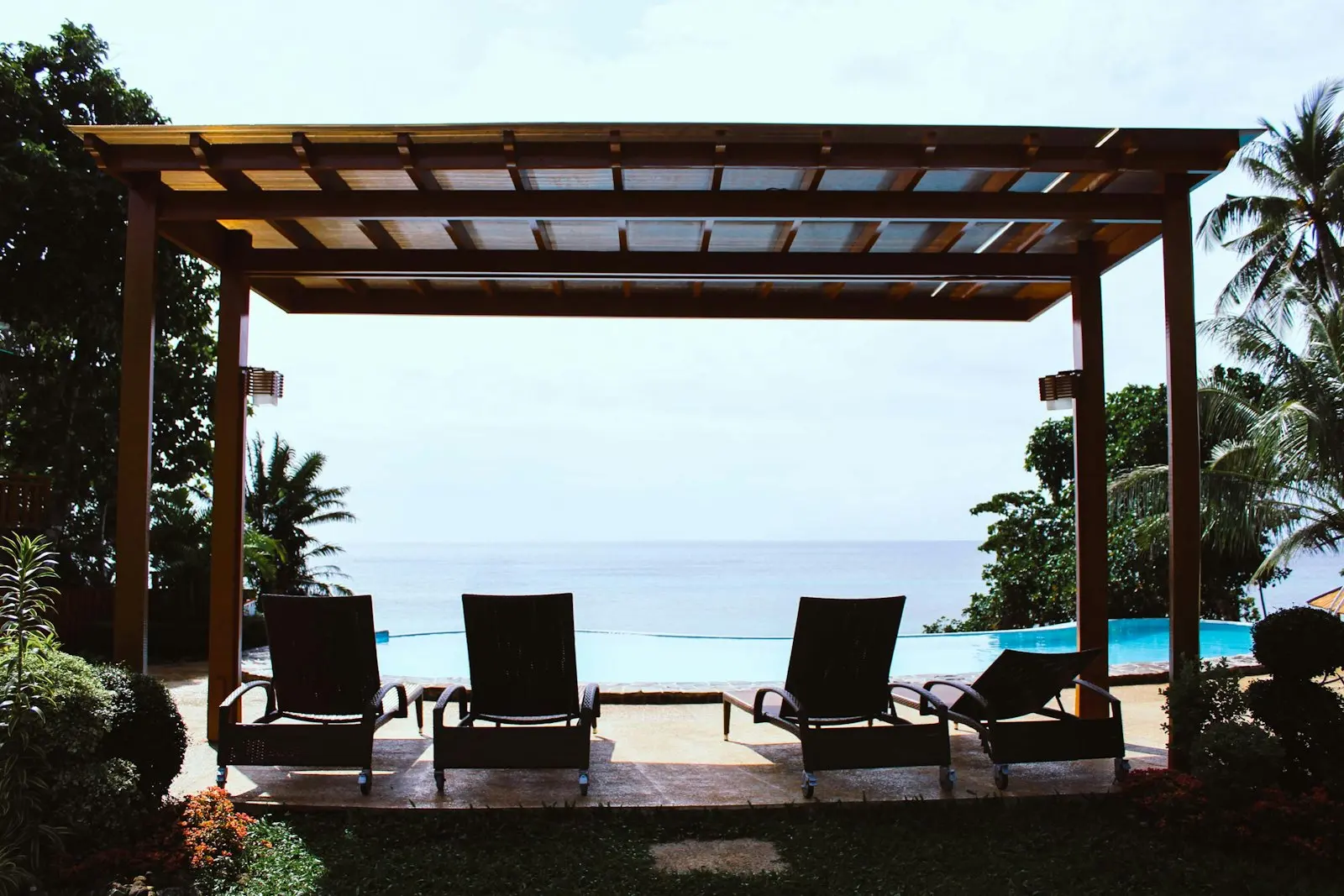
Short answer. A pool pergola works best as a freestanding structure on the pool deck or just behind it, far enough from the edge to keep the walkway clear. Pick aluminum or vinyl if you want low upkeep around splash and pool chemicals, and add a canopy or louvers if you want real shade. Check the pool barrier, setback and electrical rules with your building department before you fix the spot.
Key facts
- A pool pergola is usually a freestanding pergola set on the pool deck or just beyond it, commonly 10 by 10 to 12 by 16 feet.
- Powder-coated aluminum and vinyl are the pergola materials that cope best with pool splash, while steel needs an intact coating and wood needs regular sealing.
- A pool lounge chair is typically about 6.5 feet long and 2 to 2.5 feet wide, so two loungers with a side table need a pergola about 10 feet wide.
- A pergola with an open slatted top commonly blocks only part of the midday sun, so a poolside pergola meant for real shade needs a canopy, louvers or a solid cover.
- A pergola near a swimming pool must not weaken the pool barrier, and local pool codes decide what may stand next to the fence.
Where should a poolside pergola go?
Next to the pool, not at its very edge. Most owners place it on the wide side of the deck, or on a pad just beyond the deck, so the path around the water stays open.
Four things decide the spot:
- The sun. Watch where the shade falls in mid-afternoon in summer. The shade of a pergola moves, and by late afternoon it often lands beside the structure, not under it.
- The walkway. Leave a clear, dry path between the posts and the water. Wet feet and a post base in the way are a bad mix.
- The view of the water. If children swim, the seats under the pergola should face the pool with nothing blocking the view.
- The rules. Property-line setbacks, the pool barrier and overhead power lines can each rule out a spot.
A pergola fixed to the house can also shade the end of a pool close to the wall. The trade-offs are in attached vs freestanding pergolas. For a pool that sits away from the house, a freestanding pergola is the usual answer.
What is the best material for a pool pergola?
Aluminum or vinyl for low upkeep, wood for looks if you accept the upkeep. Pool water is hard on finishes: chlorine and salt systems both speed up corrosion, and the deck stays wet for much of the day.
| Material | Around pool water | Upkeep | Cost level |
|---|---|---|---|
| Powder-coated aluminum | Does not rust. The coating can chalk or pit over time in salt air or near a salt pool | Rinse with fresh water now and then | Middle to high |
| Vinyl (PVC over a frame) | Not affected by splash. Can show mildew in shade | Wash as needed | Middle |
| Cedar or redwood | Holds up when sealed. Post bases should not sit in standing water | Seal or stain every year or two | Middle to high |
| Pressure-treated pine | Resists rot but can warp and crack in sun and wet cycles | Seal regularly | Low |
| Powder-coated steel | Rusts where the coating is chipped or at cut edges and bolt holes | Touch up chips quickly | Low to middle |
Look at the hardware as well as the frame. Stainless or coated fasteners matter more here than in a dry yard. More detail on each option is in our pergola materials guide.
What size pergola fits beside a pool?
Size it to the furniture, then add walking room. A pool lounge chair is typically about 6.5 feet long and 2 to 2.5 feet wide.
- 10 by 10 feet: two loungers and a side table, or a small bistro set.
- 10 by 12 or 12 by 12 feet: three loungers, or a sofa and two chairs.
- 12 by 16 feet and up: four loungers, or a lounge set plus a dining table.
Kit sizes are usually named after the roof. The space between the posts is smaller, so read the post-to-post figure on the spec sheet before you match it to your deck.
How much shade does a pool pergola give?
An open-top pergola gives partial shade only. For shade you can count on at midday, the top has to close.
- Slatted top: striped, moving shade. Pleasant, but you can still burn under it.
- Retractable canopy: fabric you pull out when needed.
- Louvered roof: slats that tilt from open to closed, and shed light rain when closed.
- Side shades or curtains: useful late in the day, when the sun comes in low from the west.
Fabric near a pool gets wet and fades faster. Check that the canopy can be removed for winter and that a replacement is sold. Our guide to pergola shade compares the options.
What rules apply to a pergola near a swimming pool?
The same structure rules as any pergola, plus the pool rules. The pool rules are local, so the building department is the place to ask.
- Pool barrier. Most places require a fence or barrier around a pool. A pergola, a bench or a planter next to that fence must not make it easier to climb or leave a gap. Ask what is allowed beside the barrier.
- Setbacks. Towns set distances from property lines, and some set distances from the water. Easements for utilities count too.
- Electricity. Lights, fans, heaters and outlets near a pool fall under strict electrical rules. Have a licensed electrician plan and install anything wired, and do not run extension cords across a pool deck.
- Overhead lines. A pergola should not go under power lines. Call the utility if lines cross the yard.
- Permit and HOA. See when a pergola needs a permit.
How do you anchor a pergola on a pool deck?
With the anchors the manual names for your surface, set into concrete that is thick and sound enough to hold them. A pool deck is not always that.
- Pool decks are often thin slabs, and pavers are loose units on sand. Neither is a sure anchor point. Many installs need a footing poured under each post.
- Pipes and conduits for the pool often run under the deck. Find out where they are before anyone drills or digs.
- Keep post bases out of the low spots where water collects.
A hot tub beside the pool raises a different set of questions: see hot tub pergolas.
What to check before you buy
- The spot, checked against the afternoon sun, the walkway and the pool barrier.
- The post-to-post size against your deck and furniture.
- The frame material, the finish and the fastener type on the spec sheet.
- The anchor method in the manual for your surface, and the wind figure the maker publishes.
- The answer from the building department and the HOA.
We compare published specs only. The manual of the exact model and your local officials have the final word.
Common questions
Can you put a pergola next to a pool?
Yes. A poolside pergola is common and most kits can be anchored to a concrete pool deck. Check the setback, pool barrier and electrical rules with your local building department before you choose the spot.
What is the best material for a pool pergola?
Powder-coated aluminum and vinyl resist pool splash and humidity with little upkeep. Wood works when it is sealed regularly, and steel is the most exposed to rust if the coating gets chipped.
How big should a poolside pergola be?
A 10 by 10 foot pergola covers two loungers and a small table. A 12 by 16 foot pergola covers four loungers or a lounge set. Measure the furniture and add walking room on the pool side.
Can a pergola go over part of a swimming pool?
Some custom designs span a corner or a shallow ledge, but that is a builder's job, not a kit job. Posts, anchors and any wiring near water raise structural and electrical questions that need a professional and a permit check.
Do I need a permit for a pool pergola?
It depends on your town and the size of the structure. Pool areas often have extra rules for barriers, setbacks and electrical work, so ask the building department before you order.