Short answer. You can screen in a pergola four ways: mosquito netting curtains, manual roll-down screens, motorized track screens or fixed framed panels. Netting is the low cost start and motorized screens are the cleanest. None of them stops insects unless the top is closed too, so plan the roof and the screens together.
Key facts
- A pergola can be screened with mosquito netting curtains, manual roll-down screens, motorized track screens or fixed framed screen panels.
- A screened pergola only keeps insects out if the top is closed too, with a solid roof, closed louvers or a netting ceiling.
- Standard fiberglass insect screen is commonly an 18 by 16 mesh, and finer no-see-um screen is commonly a 20 by 20 mesh.
- Motorized pergola screens that lock into side tracks stay in place in more wind than loose netting curtains, and each one has a wind limit set by its maker.
- Solar screen fabric for a pergola is commonly sold as blocking about 80 to 95 percent of the sun, and it also reduces air flow and the view.
How do you screen in a pergola?
By closing each opening between the posts with mesh, then closing the top and the gaps. The four ways to do the sides differ mostly in cost, in how they open and in how well they seal.
| Screen type | How it opens | Seal against insects | Wind | Cost level |
|---|---|---|---|---|
| Mosquito netting curtains | Slide and tie back | Fair. Gaps at the floor and where panels meet. | Tie back or remove | Low |
| Manual roll-down screens | Crank or pull, roll up into a housing | Good with side tracks, fair without | Moderate | Mid |
| Motorized track screens | Remote or wall switch | Very good. Edges lock into the tracks. | Best of the four, within the maker's limit | High |
| Fixed framed panels with a screen door | Do not open, except the door | Very good when built tight | Good, and they pass wind load to the frame | Mid |
Netting curtains
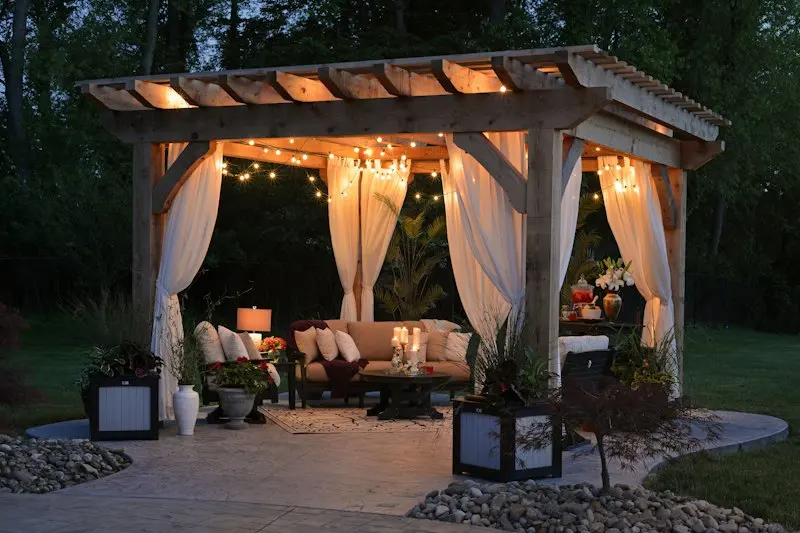
Mesh panels hang from a rod, wire or track on each side and close with a zipper, magnets or an overlap. Weighted hems help them hang straight. They are simple to add to any pergola. Hanging hardware and fabric choices are the same as for pergola curtains.
Roll-down screens
The mesh rolls into a housing fixed under the beam and pulls down to the floor. Versions with side tracks hold the edges. Versions without tracks hang free and leave gaps at the posts. Check the widest opening one screen can cover. Wide spans may need a center post or two screens.
Motorized screens
A tube motor in the housing runs the screen up and down. In the common zipper track design, the fabric edges lock into the side tracks, so the screen stays tight and sealed. They need power at each housing, or a solar or battery motor. They are often sold with motorized pergolas as an option.
Fixed panels
Wood or aluminum frames filled with screen are fastened between the posts, with a screen door on one side. This is the screened porch method. It is the most permanent, and the one most likely to matter for a permit.
Does a screened pergola need a roof?
Yes, if the goal is to keep insects out. An open pergola top is a hole as large as the floor.
The ways to close it:
- A solid roof. Polycarbonate or metal panels close the top and keep rain off. Seal the ribs at the edges with closure strips. See pergola covers.
- Louvers. A louvered roof is closed when the blades are shut. Open blades let insects in.
- A netting ceiling. Mesh stretched over or under the rafters keeps the open-sky feel. It collects leaves and has to come down before snow.
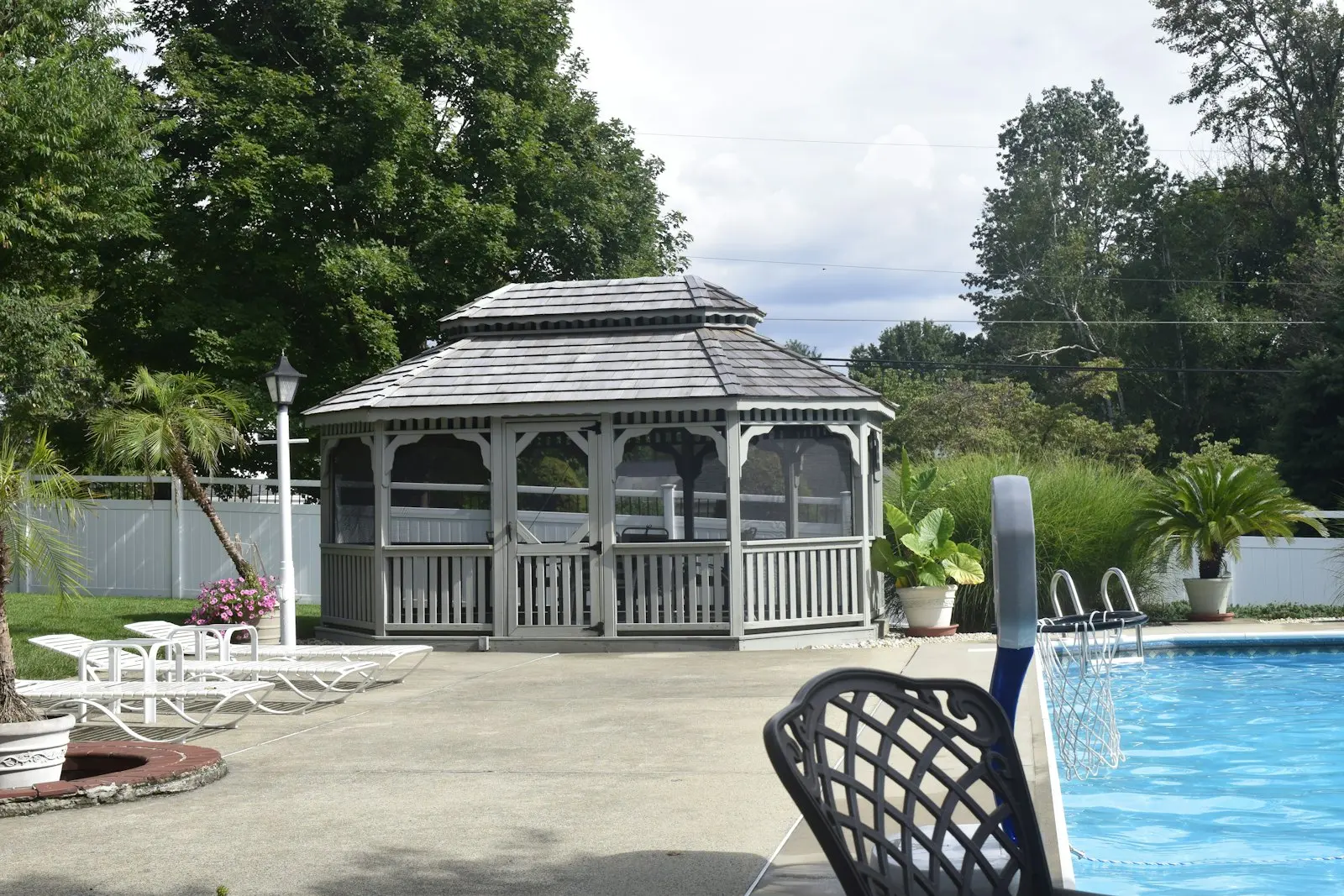
If a closed top is the main goal, a screened gazebo is sold with a roof and matching screens as one rated kit, which is often simpler.
Which screen mesh should you choose?
Standard insect mesh for mosquitoes and flies, a finer mesh where biting midges are a problem, and solar mesh when shade and privacy matter as much as bugs.
| Mesh | Stops | Air and view | Notes |
|---|---|---|---|
| Standard fiberglass, commonly 18 by 16 | Mosquitoes, flies | Best air flow and view | The usual window screen. Low cost, tears more easily. |
| No-see-um, commonly 20 by 20 | Smaller biting insects too | Slightly less air | Common near coasts and marshes. |
| Vinyl-coated polyester | Mosquitoes, flies | Slightly less air | Thicker strands that resist pets and bumps. |
| Solar screen | Insects, and commonly about 80 to 95 percent of the sun | Noticeably less air, dimmer view | Adds daytime privacy. Darker colors give a clearer view out. |
The two numbers of a mesh count are the strands per inch in each direction. Higher numbers mean smaller holes.
Where do insects still get in?
Through the gaps, not the mesh. A screened pergola is only as tight as its worst opening.
- The floor line. Pavers and decks are rarely flat. Look for a weighted bar with a brush or rubber seal at the bottom of each screen.
- Deck boards. Gaps between boards let insects up from below. On a pergola on a deck, mesh stapled under the joists closes them.
- Posts and beams. Screens without side tracks leave a slot at each post.
- Roof edges. Open panel ribs and the space between rafters above the beam.
- The entry. A zipper or magnetic closure that people leave open.
Does adding screens change the wind load or the permit?
It can change both. Mesh lets most air through, but a full wall of it still pulls on the posts in a gust, and solar screen pulls harder.
Ask the pergola maker whether the frame is approved for screens, and keep the posts well anchored. Retract or tie back screens in strong wind unless the maker's wind limit says otherwise. On permits, soft netting is rarely an issue. Fixed screen walls under a solid roof can count as a screened room. Rules vary by city and county, so ask the local building department first.
What to check before you buy
- Your top: solid, louvered or open, and how you will close it.
- The clear width and height of each opening, measured in three places.
- Whether the posts are square and plumb enough for side tracks.
- The mesh type and color.
- The bottom seal, and how flat your floor is.
- Power for motors, with outdoor wiring done by a licensed electrician.
- The maker's wind limit, and what to do in winter.
- Whether the pergola maker allows screens on that frame.
Common questions
Can you screen in a pergola?
Yes. You can hang mosquito netting curtains, fit roll-down screens between the posts or build fixed screen panels. To keep insects out, the top has to be closed as well, with a roof, closed louvers or netting.
What is the cheapest way to screen in a pergola?
Mosquito netting curtains on a rod, wire or track. They cost the least and tie back when not needed. They also leave the most gaps and come down for winter.
Do screens work on a pergola with an open roof?
Only partly. Side screens cut down on insects that fly low and give some privacy, but mosquitoes come in through an open top. Add a netting ceiling or a solid cover for a real barrier.
Do I need a permit to screen in a pergola?
Sometimes. Fabric netting rarely matters, but fixed screen walls and a solid roof can turn a pergola into a screened room for the building department. Rules vary, so ask before you build.
Can pergola screens stay down in wind?
Loose netting should be tied back or taken down in wind. Track-guided screens handle more, up to the wind limit given by the maker, and many motorized ones can retract on a wind sensor.