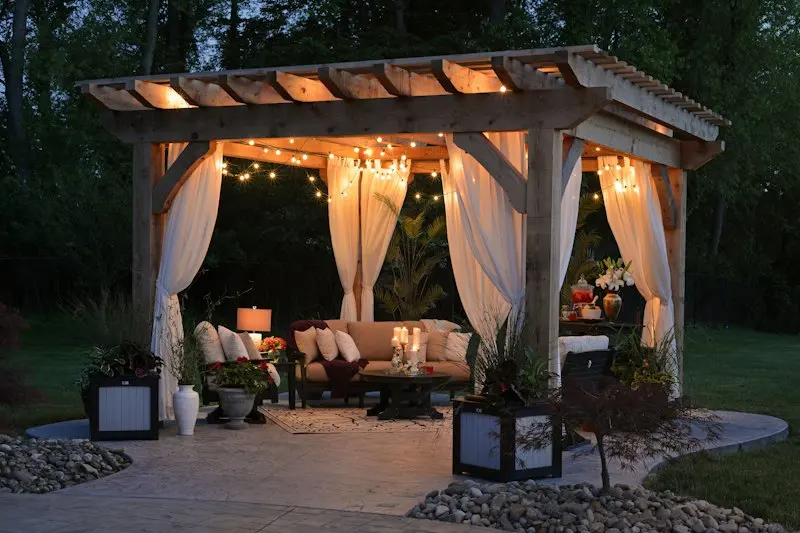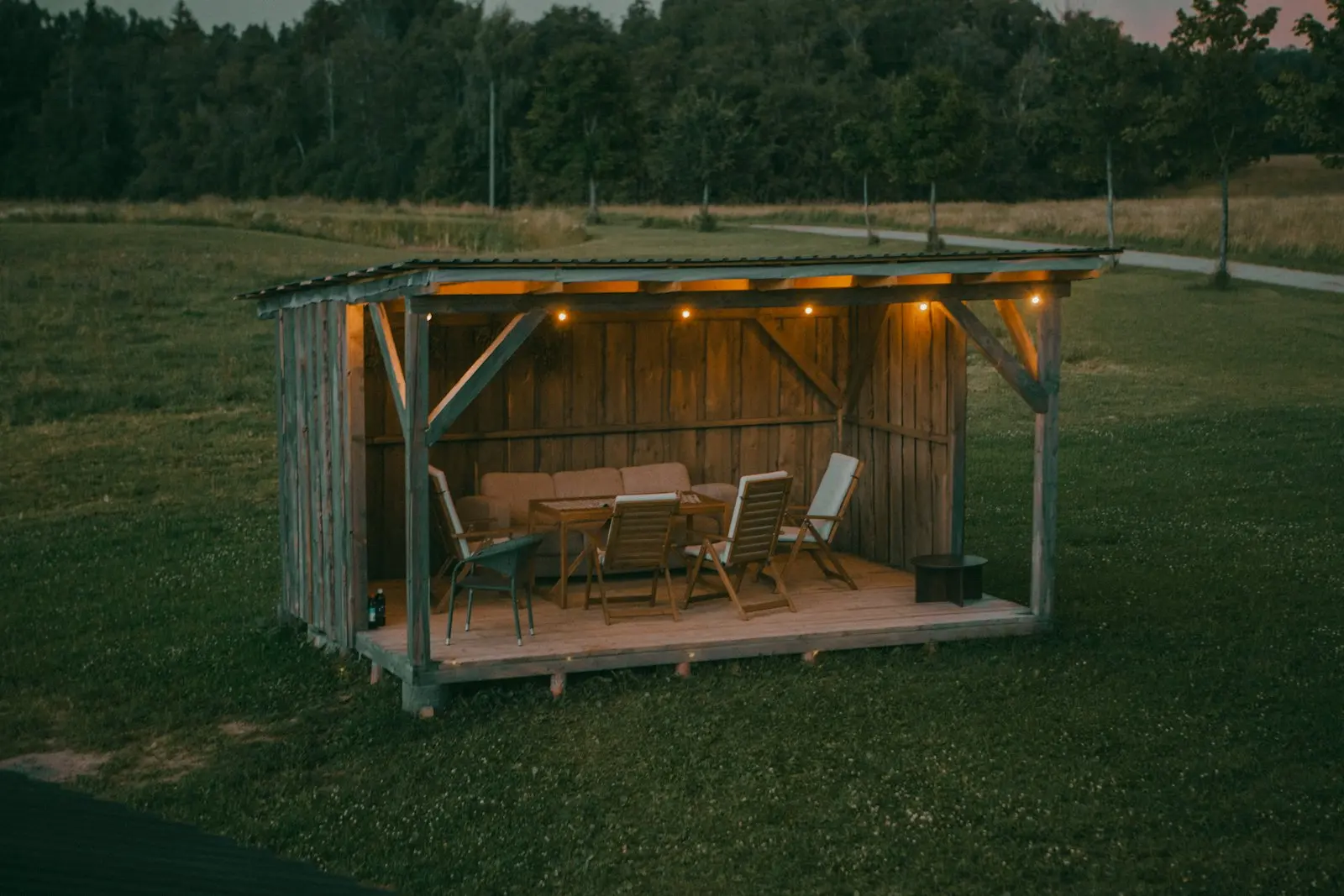
Short answer. For most pergolas, outdoor string lights plugged into a GFCI-protected outdoor outlet are the simplest lighting. Choose solar where there is no outlet, and low-voltage or hard-wired fixtures for a pergola you use most evenings. Because an open pergola roof lets rain through, look for a wet location rating on the label of every light.
Key facts
- Lights on an open pergola are exposed to rain, so the product label should say the light is suitable for wet locations, not only damp locations.
- The outline of a 10 by 10 foot pergola is about 40 feet, and the outline of a 12 by 12 foot pergola is about 48 feet, before any extra length to reach the outlet.
- Low-voltage pergola lighting typically runs at about 12 volts from a plug-in transformer, while plug-in string lights run on standard 120 volt household power.
- Warm white pergola lights are commonly labeled about 2,700 to 3,000 kelvin, which gives a soft yellow light for seating and dining areas.
- Hard-wired pergola lights need a new outdoor circuit, which is a job for a licensed electrician and often needs a permit.
What are the best lights for a pergola?
String lights are the most common choice, because they weigh little and clip to the rafters. The best type for you depends on where your power comes from and how bright you want the space.
| Power | Brightness | Install | Cost level | |
|---|---|---|---|---|
| Solar string lights | Small panel and battery | Low | Clip on, no wiring | Lowest |
| Plug-in string lights | Outdoor outlet, 120 volts | Medium | Clip on, route one cord | Low |
| Low-voltage strips or spots | Plug-in transformer, typically about 12 volts | Medium, easy to aim | Run thin cable along the beams | Medium |
| Hard-wired fixtures | Dedicated outdoor circuit | Highest, on a wall switch or dimmer | Licensed electrician | Highest |
Which rating do lights for a pergola need?
Look for the words "suitable for wet locations" on the label. An open or slatted roof does not keep rain off the lights, so a damp location rating is not enough.
The two terms mean different things on US product labels:
- Damp location: for covered spots that get moisture but no direct water, such as a deep covered porch.
- Wet location: for spots where rain or sprinkler water can reach the light directly.
A pergola with a solid cover is better protected, but wind still pushes rain in from the sides. A wet location rating is the safer choice under any pergola. If you plan to close the roof, see pergola roof options.
Check also that the listing says "outdoor" for the cord, the plug and any transformer or timer, not only for the bulbs.
How do you hang string lights on a pergola?
Fix the string to the frame at short intervals, so the cord does not carry its own weight over a long span. Start at the end nearest the outlet.
- Pick a pattern: around the outline, in a zigzag across the rafters, or in straight runs along each rafter.
- Measure the path with a cord or a tape. Add the distance down the post to the outlet.
- Screw cup hooks or outdoor cable clips into wood. On aluminum or vinyl, use clamps, zip ties or magnetic hooks made for that material, since drilling can affect the finish warranty.
- Hang the string without bulbs if they are removable, then fit the bulbs.
- Leave a small loop below the plug so water drips off before it reaches the outlet.
For a span between two posts with nothing in between, many makers tell you to hang the string from a guide wire. Read the manual for the longest unsupported span.
How many feet of string lights does a pergola need?
Enough to follow your pattern plus the run to the outlet. The outline is the shortest pattern, and a zigzag can need two to three times as much.
- 10 by 10 foot pergola: the outline is about 40 feet.
- 10 by 12 foot pergola: about 44 feet.
- 12 by 12 foot pergola: about 48 feet.
- 12 by 16 foot pergola: about 56 feet.
Strings are commonly sold in lengths of about 25, 50 and 100 feet. The box states how many strings you may connect end to end. Do not go past that number.
Solar or plug-in lights: which is better?
Plug-in lights are brighter and work every night. Solar lights are easier to add and need no outlet, but they depend on the sun the panel got that day.
A solar string has a small panel that charges a battery. The panel needs several hours of direct sun, and the pergola itself, a tree or the house can shade it. Check the cord length between the panel and the first bulb, so you can place the panel in the sun. Expect less light in winter and after cloudy days.
Plug-in strings need an outdoor outlet with GFCI protection and a cover that closes over the plug. If the nearest outlet is far away, a permanent run of extension cord across the lawn is not a good answer. A new outlet on or near a post is a job for an electrician.
Do you need an electrician for pergola lighting?
No for solar and plug-in lights on an existing outdoor outlet. Yes for anything wired into the house: a new outlet, a switch, a ceiling fixture or a fan.
Hard-wired work outdoors has its own rules for cable, boxes, burial and protection. They vary by place, and a permit is common. A licensed electrician will size the circuit and choose the parts. Tell them early if you also want a fan or a motor on the same pergola. The same points apply to a ceiling fan under a gazebo and to a motorized pergola.
Some pergola kits come with channels in the posts or beams for cable, or with LED strips built in. If you have not bought yet, how to choose a pergola kit lists what to compare.
Pergola lighting ideas that work
- Outline only: one string around the top beams. It uses the least cord and suits a small pergola.
- Zigzag canopy: string run back and forth across the rafters, for even light over a table.
- Hidden strips: low-voltage LED strips on top of or behind the beams, so you see the glow and not the source.
- One task light: a wet-rated pendant or spot over the table or the grill, added to softer strings.
Warm white, commonly labeled about 2,700 to 3,000 kelvin, is the usual pick for seating. A dimmer or a timer made for outdoor use helps more than extra bulbs. For a roofed structure, see gazebo lights, where the covered roof changes the options.
What to check before you buy
- "Suitable for wet locations" on the label, and "outdoor" for the cord, plug and transformer.
- Total length for your pattern, plus the run to the outlet.
- How many strings the maker allows end to end.
- Whether the lights are sold for seasonal or permanent outdoor use.
- For solar: cord length to the panel and a sunny spot for it.
- An outdoor outlet with GFCI protection and an in-use cover within reach.
We compare published specs only. The product label and the manual of the exact lights have the final word.
Common questions
What kind of lights are best for a pergola?
Outdoor string lights are the usual choice because they are light, cheap to add and easy to remove. Low-voltage or hard-wired fixtures suit a pergola you use most evenings and want on a wall switch.
How many feet of string lights do I need for a pergola?
Measure the path the string will follow. The outline of a 10 by 10 foot pergola is about 40 feet and a 12 by 12 is about 48 feet. A zigzag across the roof needs more, plus the distance to the outlet.
Can pergola lights stay up all year?
Only if the label says they are rated for permanent outdoor use in wet locations. Many string lights are sold for seasonal use, so read the box and the manual before you leave them up through winter.
Do solar pergola lights work well?
They work for a soft glow where the panel gets several hours of direct sun. They are dimmer than plug-in lights and fade on short or cloudy days, so they suit mood lighting more than dining or cooking.
Do I need an electrician for pergola lighting?
Not for solar lights or for plug-in lights on an existing outdoor outlet with GFCI protection. You do for a new outlet, a wall switch or any hard-wired fixture.